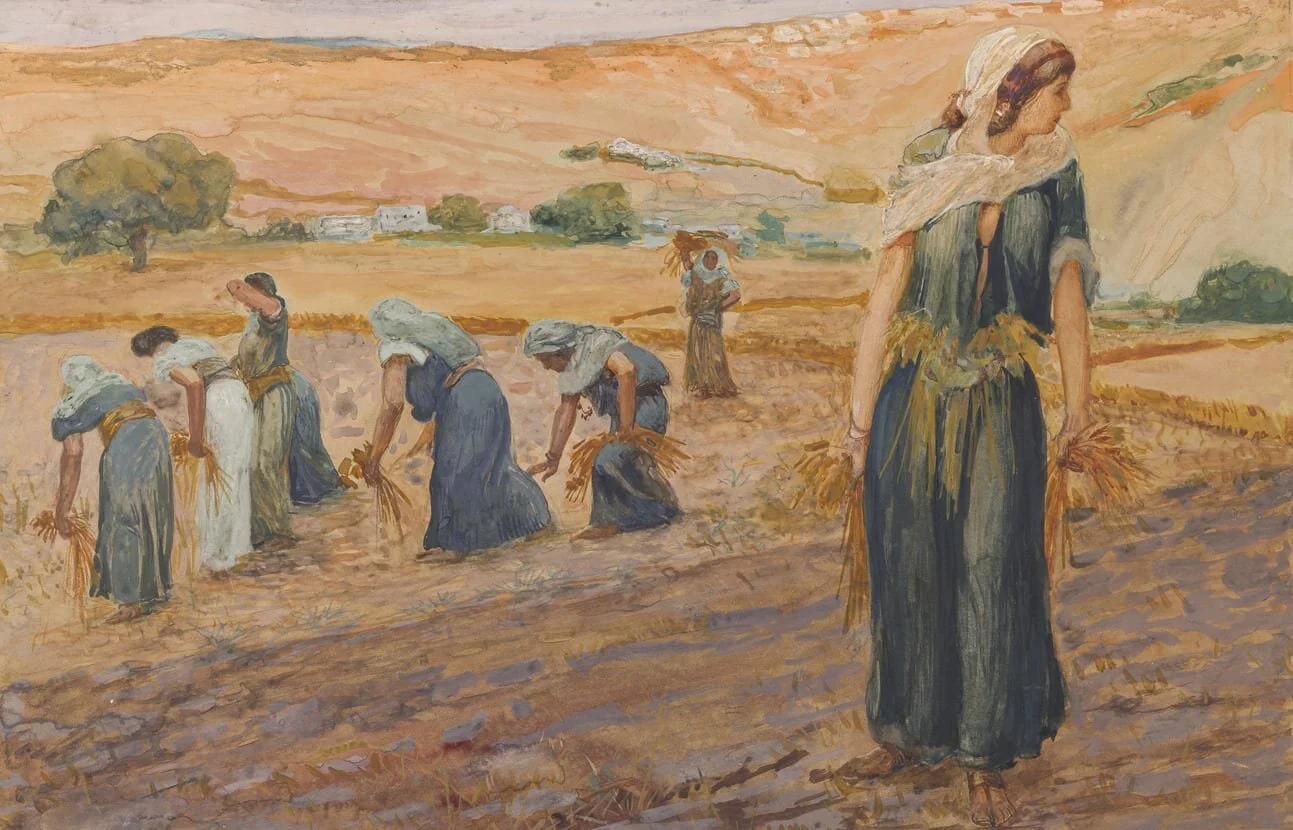
James Jacques Joseph Tissot: Ruth Gleaning (Ruth glanant)
Recap
In our previous study, we began to examine the book of Ruth, focusing on chapter 1 and its connections to Judges, the failure of the Hebrew people to follow the law, and the consequences that followed.
Due to the famine in Israel, specifically Bethlehem (which translates to house of Bread), a family moves to the land of Moab in search of food and spouses for their sons. It should be noted that this action was specifically prohibited in the Old Testament law.
Three funerals follow the two weddings, and all the men in the family die, leaving the three women, Naomi, Ruth, and Orpah, as widows. But Naomi heard the famine had finished and decided to return home. She tried to send her two daughters back to their families, but Ruth refused to leave. Ruth declared a sort of covenant with Naomi, “where you go I will go, and where you stay I will stay. Your people will be my people and your God my God. Where you die, I will die, and there I will be buried. May the Lord deal with me, be it ever so severely, if even death separates you and me” (Ruth 1:16-18)
Ruth and Naomi return to Bethlehem, but Naomi tells the women of Bethlehem who welcome her home, “Do not call me Naomi (which means pleasant or delight), call me Mara, because the Almighty has made my life very bitter.” (Ruth 1:20)
Introduction:
Our reading today turns its attention to Ruth, as she seeks to support Naomi through the work of gleaning. Gleaning, or picking the leftover grain, was a practice protected by God in the laws of Leviticus (Lev 23:22). The Israelite people were told not to gather right to the edges of their field, and not to pick up that which had fallen during their reaping, so that the poor and foreigners could have food through the work of their hands.
Alongside this law of gleaning, we also hear mention of something called a Guardian (kinsman) Redeemer. This is another provision instructed in the law of Leviticus, in which if a family fell on hard financial times and had to sell off or give up their land or property, a family member who had the means was to come and buy the land and give it back to the family, (Lev 25:25). Ruth benefits from this law, and Boaz extends this law, providing additional care and provision for Ruth as she gleans at his fields.
There is so much here, so let’s dive in and read chapter 2!
[Read the passage out loud]
Three Quick Questions
1. Did anything stand out for you in the passage? (Look for repetition & contrasts)
2. Did you learn anything new or surprising about Jesus or God’s character?
3. Are there other stories or passages in Scripture that this passage might be referencing?
Why do you think the authors are connecting these passages?
Digging Deeper
Even though God is not directly described as acting, how do we see God's provision and faithfulness in Ruth 2? What does this teach us about recognizing God's work in our everyday lives? (Proverbs 16:9)
What does the law of gleaning teach us about God’s character? (Lev 23:22).
Why do you think God still requires the foreigner and the poor to work to get their own grain instead of simply being handed the grain from the farmer?
What are the ways that we could follow these principles in our lives?God’s provision finds its way to Ruth through a man properly following the law. Does this challenge or change the way you see the purpose of the law?
Have you experienced something similar to Ruth in this chapter?Twice in Ruth, we have encountered the word Hesed (kindness, or loyal love). In chapter 1, Naomi prays that God would treat Ruth with Hesed, kindness/gentle love, and here in Chapter 2, Boaz treats Ruth with Hesed.
What do you see as the key components/ingredients of this kindness or love?
How might this idea reshape the way we approach our daily lives? Our work? The food we eat? Our household?
Benediction
Finally, brothers, rejoice. Aim for restoration, comfort one another, agree with one another, live in peace; and the God of love and peace will be with you.