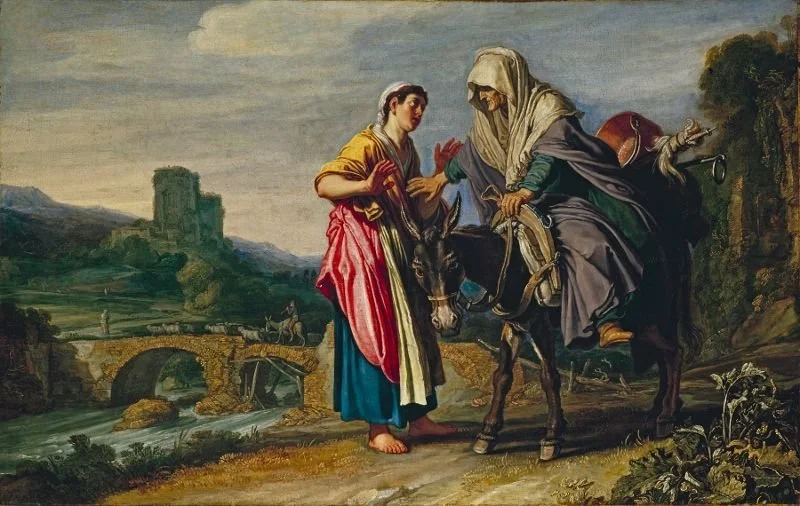
Pieter Lastman, Ruth declares her loyalty to Naomi,, 1614
Introduction to Ruth.
Ruth is a curious book in the Bible for a few reasons.
1. It is a romance story about how Ruth comes to marry Boaz.
2. The actions of God are not described by the narrator; rather, God is only mentioned within the conversations of the characters.
3. There are moments when the Deuteronomic law is followed to the letter, as is the case with the laws around gleaning and kinsman redeemers; But there are also moments when the law is disregarded, such as the laws around marrying foreigners, specifically Moabites.
Yet these are not unintentional features; rather, within these oddities of Ruth, there is great treasure to be found.
Old Testament Theologian Ellen Davis describes the book of Ruth this way:
Ruth is a story of personal relationships that prove to be redemptive in the lives of a few ordinary people — yet ultimately point in the direction of hope for Israel as a whole. Uniquely in the bible, this short story enables us to dwell for a season in the world of the Israelite family, in the small farming town of Bethlehem, just a few miles down the road from Jerusalem, where Ruth’s great-grandson will one day be enthroned as king. The trajectory of the whole story might be summarized in the words of the apostle Paul:
Suffering produces endurance;
And endurance, character;
And character, hope. (Rom 5:3-4)
A note on placement within the Canon.
It is important to note that the placement of Ruth in the Christian Bible differs from the Jewish ordering of the Canon. The Jewish ordering places Ruth near the books of Proverbs, Psalms, Job, and Song of Solomon. While in the Christian bible, Ruth is placed directly after the book of Judges.
These placements are not accidental.
The Jewish placement highlights the book’s examination of wise living under the law, as well as provides a real example of the “valorous woman” from Proverbs 31. As we read Ruth, we are challenged with what faithfulness to God and his law looks like, as well as what faithfulness looks like towards others; thus, it is included with the Wisdom writings.
The Christian placement after Judges highlights the unfolding story of God's plan of salvation. God works in history. As Israel drifts further and further from him, the central question emerges: How will God save a people who repeatedly turn away from him? Ruth provides a quiet, powerful answer.
A note on Judges
Regardless of where the book is placed in the Bible, it has a deep connection to the book of Judges as seen in the opening words. “In the days when the judges ruled, there was a famine in the land.”
This book is in conversation with Judges; it is a mirror to that book. So we should remember that Judges portrays the steady moral and spiritual decline of Israel. Throughout Judges, violence becomes increasingly pervasive, with particular attention given to the escalating abuse of women and other vulnerable people. This exposes the depth of Israel's rebellion and illustrates just how far, and how quickly, the nation has strayed from God's covenant love.
At the end of Judges, we read that “In those days Israel had no king; everyone did as they saw fit.” Ruth offers a very different story.
With all that in mind, let’s begin our meditation on the book by reading chapter 1.
[Read Ruth 1 aloud]
Three Quick Questions
1. Did anything stand out for you in the passage?
2. Did you learn anything new or surprising about Jesus or God’s character?
3. Are there other stories or passages in Scripture that this passage might be referencing?
Why do you think the authors are connecting these passages?
Digging Deeper
The story of Ruth begins with everything falling apart.
Have there been moments in your life when it felt like everything was falling apart? How did you respond?Verses 1 & 2 describe famine in Bethlehem (which translates to House of Bread). Read Deuteronomy 28:1–2 and 28:15–24,
What do these passages reveal about the opening sentences of Ruth?Even though God's name is mentioned, He never speaks or performs an obvious miracle in this chapter.
Why do you think the author writes this way?How does Naomi view God's role in her suffering?
Do you agree with her view, or where does it challenge how you see God at work?Reread Ruth 1: 16-18 (Ruth’s declaration). What does her declaration teach us about what faithfulness looks like?
Like Ruth, are there things we need to leave to follow God more faithfully?The book of Ruth begins as a story of great suffering. Naomi says, “I went away full, and the LORD has brought me back empty.” This story will trace the movement from emptiness to God’s “filling.”
Are there places in your life right now that feel empty that you long to experience God’s filling and nourishment?
Benediction (At the end of the night).
Now to him who can do far more abundantly than all that we ask or think, according to the power at work within us, to him be glory in the church and in Christ Jesus throughout all generations, forever and ever. Amen.